


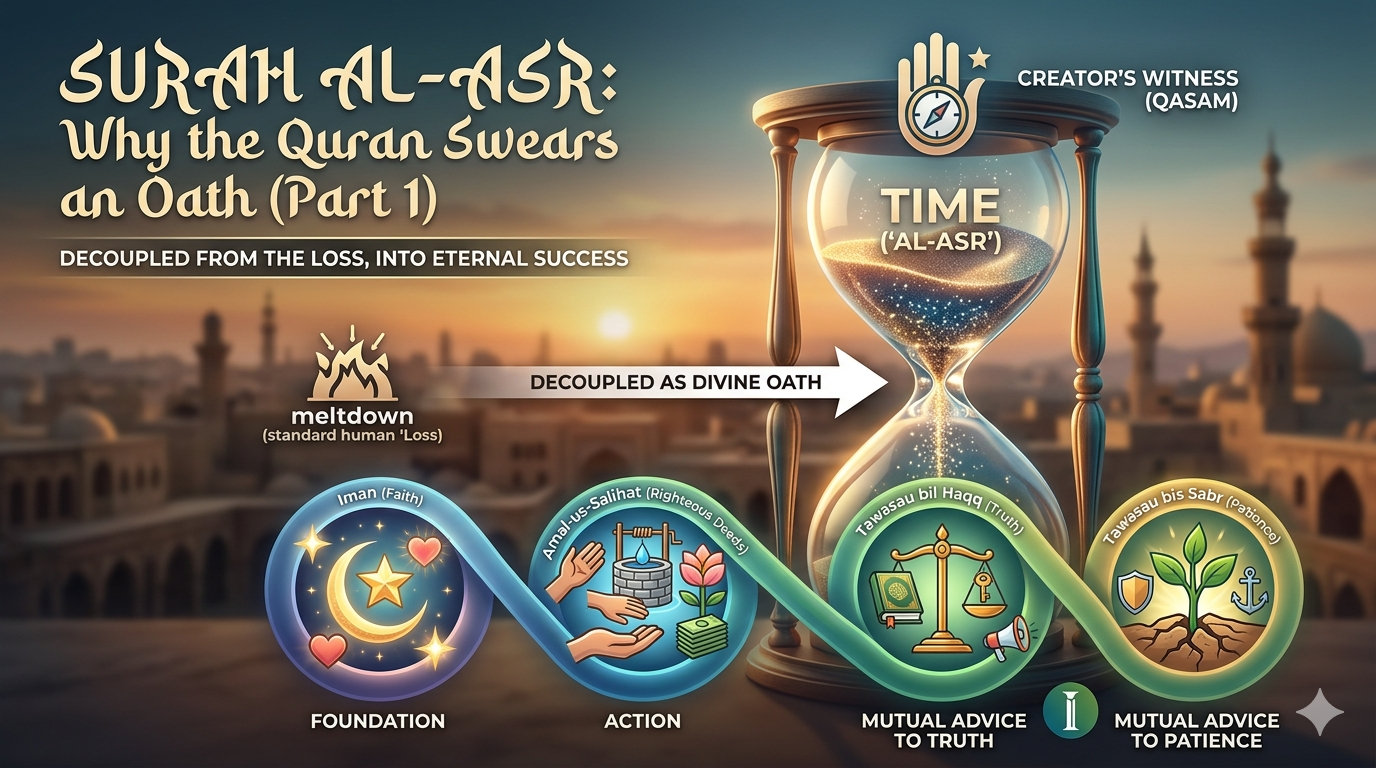
Surah Al-Asr: The Significance of the Divine Oath and the Value of Time
In the vast treasury of the Quran, there are chapters that, despite their brevity, contain the entire essence of human existence and the blueprint for salvation. Surah Al-Asr is arguably the most profound example of such a chapter. Consisting of only three verses, it is so comprehensive that Imam Al-Shafi’i famously remarked, “If people were to ponder only over this Surah, it would be sufficient for their guidance.”
The Surah begins with a powerful linguistic tool: a Divine Oath. By swearing by “Al-Asr” (Time), Allah (SWT) sets the stage for a message of ultimate urgency. To understand why the Quran swears such an oath and what it implies for humanity, we must delve into the linguistic, historical, and spiritual dimensions of “Time.”
The Anatomy of an Oath in the Quran
In Arabic rhetoric, an oath (Qasam) is used to emphasize a point, to draw attention to the greatness of the object sworn by, and to testify to the truth of the statement that follows. When Allah (SWT) swears by a creation, it serves a dual purpose:
- To highlight the majesty of that creation: The object of the oath is a sign (Ayah) of the Creator’s power.
- To establish a link: The object of the oath usually provides the evidence for the claim that follows.
In Surah Al-Asr, the claim is that “Indeed, mankind is in loss.” The evidence for this loss is “Time” itself.
What is “Al-Asr”?
The word Asr is often translated simply as “Time,” but its linguistic roots are far more specific. It refers to time that is “pressed” or “squeezed.” It is the same root used for squeezing juice from a fruit. This implies that time is not an infinite, stagnant resource; rather, it is something that is constantly being exhausted, leaving behind only the essence of what was put into it.
Scholars have offered several interpretations of what specifically Asr refers to:
- The Era of the Prophet (PBUH): The most blessed time in human history when revelation was descending.
- *The Afternoon: The time of the ‘Asr prayer, which marks the transition from the busyness of the day to the approaching darkness of night—a reminder of the end of life.
- Time in its Totality: The entire span of human history, which stands as a witness to the rise and fall of civilizations based on their moral choices.
The Universal Condition: Mankind is in Loss
The second verse delivers a chilling verdict: “Innal insana lafee khusr” (Indeed, mankind is in a state of loss).
The use of the word Insan (Mankind) is generic, covering every human being regardless of wealth, status, or intellect. The word Khusr (Loss) in Arabic doesn’t just mean a minor setback; it refers to a merchant who has lost his capital. Our “capital” in this world is our time. Every second that passes is a piece of our capital disappearing. If that second is not traded for something of eternal value, it is a permanent loss.
Imagine a block of ice melting in the summer sun. The owner of the ice is in a state of loss unless he can sell the ice or use it before it turns to water and disappears into the earth. This is the human condition in relation to time.
The Four Pillars of Success
After establishing the problem (Loss), the Surah provides the solution. Allah (SWT) excludes from this loss only those who fulfill four specific criteria. These pillars represent a balance between individual spirituality and social responsibility.
1. Faith (Iman)
Faith is the foundation. It is the internal realization of the truth—the recognition of the Creator and the purpose of existence. Without Iman, even the most “productive” life is a loss because it is built on a fleeting, worldly foundation that ends at death.
2. Righteous Deeds (Amal-us-Salihat)
Faith must be translated into action. In the Quran, Iman and Amal are almost always mentioned together. True success requires a physical manifestation of belief through prayer, charity, honesty, and kindness. These are the “investments” that turn the melting capital of time into eternal reward.
3. Truth (Haqq)
Success is not a lonely journey. The third requirement is “Mutual Advice to Truth.” This means standing up for justice, speaking the truth even when it is difficult, and encouraging others to follow the path of righteousness. It is a call to collective integrity.
4. Patience and Constancy (Sabr)
The path of truth and faith is often difficult. Therefore, the final pillar is “Mutual Advice to Sabr.” Sabr is not passive waiting; it is active perseverance, emotional regulation, and steadfastness in the face of adversity. By encouraging one another toward patience, the community ensures that no individual falls into despair or loss.
Why the Oath is the Proof
Allah swears by Time because Time is the silent witness to the truth of this Surah. If we look at history, those who had power but no faith are now gone—their time ran out, and they left in loss. If we look at our own lives, the days we spent in vanity are gone forever, while the moments we spent in prayer or helping others remain in our “account.”
The oath by Time is a warning: The clock is ticking. The “squeezing” of our hours is inevitable. The only way to win is to change the currency of our time into the currency of the Hereafter.
Frequently Asked Questions (FAQs)
Q1: Why does the Quran swear by things like the Sun, Moon, and Time? Allah (SWT) swears by these creations to draw our attention to their importance and to use them as physical evidence for the spiritual truths He is about to mention. Swearing by Time emphasizes that our opportunity in this world is limited.
Q2: Does “Loss” in Surah Al-Asr mean financial loss? While it can include worldly failure, the primary meaning is spiritual and eternal loss. It refers to wasting the one chance we have to earn Paradise. A billionaire who wastes his life without faith is in more “loss” than a poor person with strong faith.
Q3: Why is “Mutual Advice” (Tawasau) mentioned twice? This highlights the social nature of Islam. It is not enough to be good yourself; you must work to make the environment around you good. By advising one another to Truth and Patience, we create a support system that prevents the whole community from falling into loss.
Q4: What is the significance of the ‘Asr prayer time specifically? The ‘Asr prayer occurs when the day is winding down. It is a time when people are usually at their busiest trying to finish work. Swearing by this time reminds us that in the “afternoon” of our lives, we must not let worldly business make us forget our ultimate purpose.
Q5: How can I apply Surah Al-Asr to my daily life? You can apply it by auditing your time. Ask yourself: Is what I am doing right now an investment (Faith/Good Deeds) or a waste? Am I surrounding myself with people who encourage me toward the Truth and help me be patient?
Take the Next Step with LearnMuslim
Ready to go beyond just reading about Islam and truly understand it with proper guidance?
LearnMuslim makes it easy for both kids and adults to connect deeply with the Quran through personalized one-on-one online classes. With flexible timings and qualified tutors, you can learn at your own pace from the comfort of your home. Whether your goal is to perfect Quran recitation with Tajweed, start with Noorani Qaida, or begin your memorization journey, LearnMuslim provides a supportive and structured learning experience. Female instructors are available, and you can begin your journey today with a free trial
Explore LearnMuslim’s courses and begin your free trial today:
Learn Quran with Tajweed
Noorani Qaida
Quran Memorization and more at LearnMuslim

